Tricks to Remembering Various Parts of the COLREGS
In England new navigation rules were legislated in 1862. Concerned that many seafarers would not be able to read those rules, given the literacy rates of that era, Thomas Gray, a member of the Board of Trade, introduced many rhymes that could be used to recall the meaning of parts of the rules, particularly those dealing with lights and shapes.
This method of remembering aspects of the regulations became very popular and has been extended over the years. Some rhymes have been revised as rules were changed.
More than a century and a half later, mariners still use rhymes to help them remember light and shape combinations.
An Admonition
Both in safety and in doubt,
Always keep a good look-out.
This is a reminder of Rule 5 Look-out. It's a rule that can never be emphasized too much.
Light Combinations
Some rhymes for light combinations are the following.
Red over Red
This boat is dead
Thus two all-round vertical red lights mean the vessel is not under command or "dead" in the sense it is not able to comply with the requirements of the COLREGS. There are alternatives to the second line: "Skipper is dead" or "Captain is dead". These also are meant to denote that the vessel is not under command. Hopefully neither the skipper nor anyone else is really dead.
Red over Green
Sailing machine
Two all-round vertical lights, the upper red and the lower green, is one way to distinguish a vessel under sail. There are light combinations other than green over red to designate a sailing vessel.
Red over White
Fishing boat lights
This light combination is to show a vessel engaged in fishing, other than by trawling.
Green over White
Trawling tonight
If the fishing vessel is trawling, change the red light to green. Of course, trawling doesn't need to be at night... it's just a way to help you remember.
White over White
Short tow in sight
Two vertical all-round lights denote a tug with a tow that does not exceed 200 m (so a "short tow").
White over White over White
Now it's a long tow in sight
A longer tow (more than 200 m) requires three white lights.
White over Red
Pilot ahead
Pilot boats, with the pilot on board, are to show a white light over a red. They should show this only when on pilotage duties, that is, with the pilot on board. Crews of some pilot boats can be a bit relaxed about this.
Yellow over White
My towline is tight
When a tug is engaged in towing, she should show at the stern a yellow light over the standard sternlight, both lights to be seen over an arc of 135 degrees. As with pilot boats, tugs will often claim the status associated with towing, even when not on duty; although this is more common with the diamond shape than with lights. Some tugs have the diamond shape (for towing) permanently bolted to the roof of their wheel house.
A Last Poem About the COLREGS
Here lies the body of Michael O'Day,
Who died defending the right of way.
He was right, dead right as he sailed along,
But he's just as dead as if he had been wrong.
The point here is that there is no point in always blindly following the COLREGS (loosely understood as "the right of way"). The short poem is a reminder of part of Rule 2: there could be extreme circumstances that "make a departure from these Rules necessary to avoid immediate danger".
This poem repeats a common misperception that the COLREGS contain the notion of a vessel having a "right of way". Rather than use "right of way" the COLREGS use the term "stand-on vessel", which is not the same in that the stand-on vessel has specified obligations and does not have a "right of way".
Memory Aids Provided by Station 60
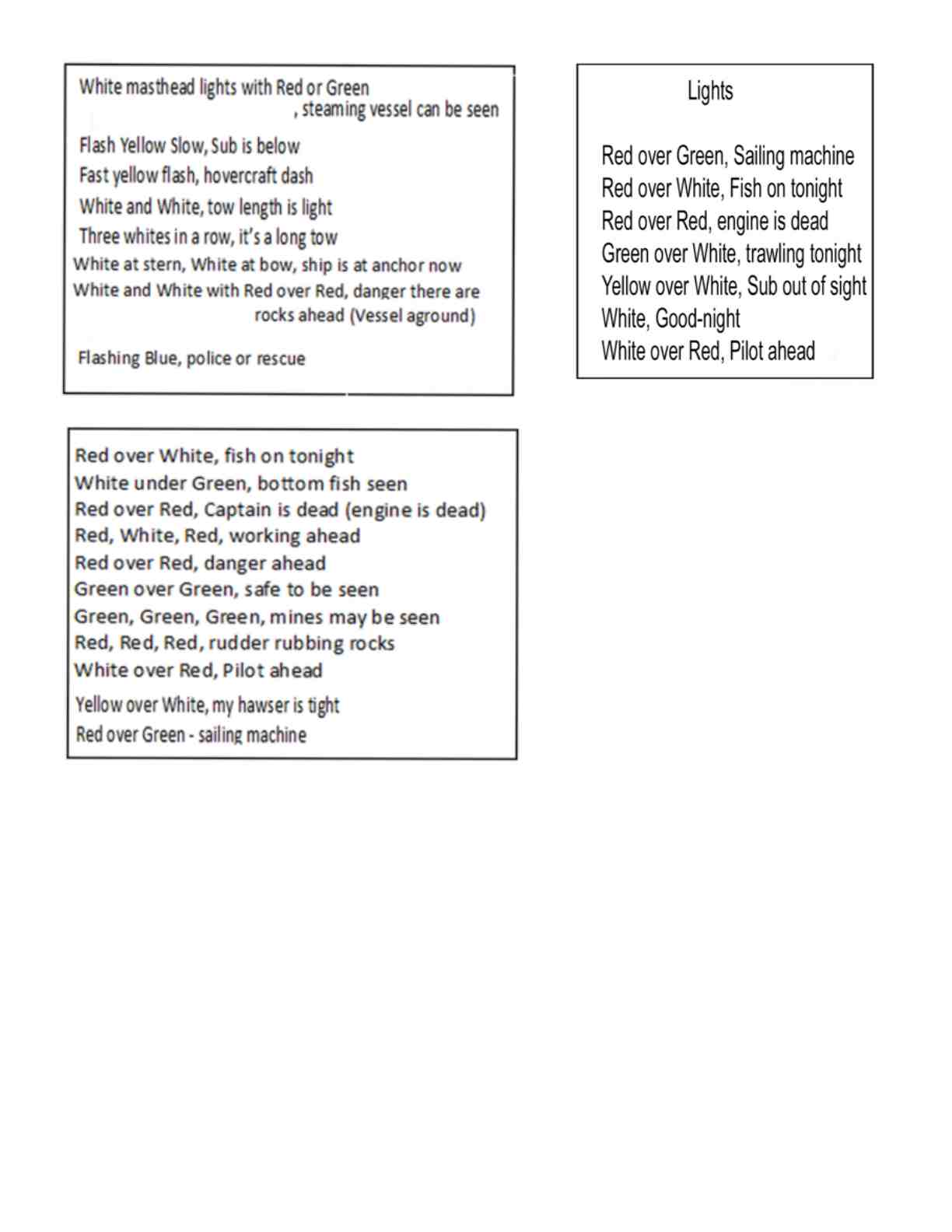 If anyone wishes to use memory aids like this, there are a number of short notes for this that are available to members of the station. Some of these are illustrated here.
However, without a more complete knowledge of the lights, some of the rhymes on their own may be a bit misleading. For example "White, Good-night" suggests that a white light indicates that a vessel is anchored (and so "good-night"). But this is not the only message you should associate with this light: a single white light can be the stern light of any type of vessel or it can be the masthead light of a distant vessel with the other lights not showing because they are out of sight below the horizon.
So, please use aids like these, if you wish, to help memorize the association of a light combination with its purpose. But make sure that you fully understand the purpose light combinations as provided in the COLREGS.