Specific Distress Signals
The various signals for distress are provided below. Many are appropriate for ocean-going commercial vessels and are not likely to be encountered our areas of responsibility. Those that might be encounter are in BOLD. Canadian modifications to the COLREGS add two more and these are shown below the 15 that are part of the International COLREGS.
ANNEX IV
DISTRESS SIGNALS — INTERNATIONAL
1 The following signals, used or exhibited either together or separately, indicate distress and need of assistance:
(a) a gun or other explosive signals fired at intervals of about a minute;
(b) a continuous sounding with any fog-signalling apparatus;
(c) rockets or shells, throwing red stars fired one at a time at short intervals;
(d) a signal made by any signalling method consisting of the group ••• — — — ••• (SOS) in the Morse Code;
(e) a signal sent by radiotelephony consisting of the spoken word “MAYDAY”;
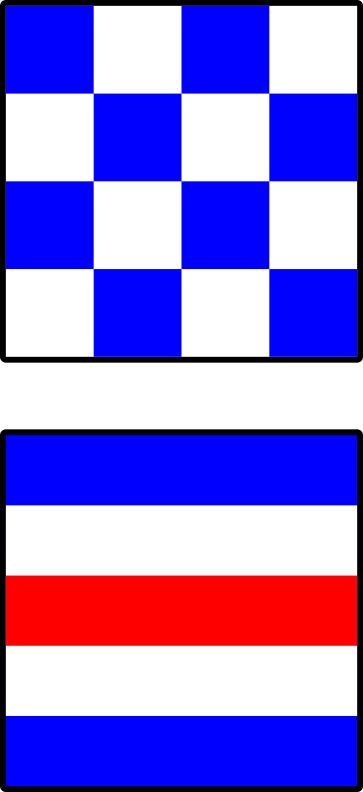
(f) the International Code Signal of distress indicated by N.C.;
(g) a signal consisting of a square flag having above or below it a ball or anything resembling a ball;
(h ) flames on the vessel (as from a burning tar barrel, oil barrel, etc.);
(i) a rocket parachute flare or a hand-flare showing a red light;
(j) a smoke signal giving off orange-coloured smoke;
(k) slowly and repeatedly raising and lowering arms outstretched to each side;
(l) a distress alert by means of digital selective calling (DSC) transmitted on
(i) VHF channel 70, or
(ii) MF/HF on the frequencies 2 187.5 kHz, 8 414.5 kHz, 4 207.5 kHz, 6 312 kHz, 12 577 kHz or 16 804.5 kHz;
(m) a ship-to-shore distress alert transmitted by the ship’s Inmarsat or other mobile satellite service provider ship earth station;
(n ) signals transmitted by emergency position-indicating radio beacons;
(o) approved signals transmitted by radiocommunications systems, including survival craft radar transponders.
The two signals added in a Canadian modification to the COLREGS are:
(a) a square shape or anything resembling a square shape; and
(b) a high intensity white light flashing at regular intervals of 50 to 70 times per minute.
 NOTE:
NOTE:
2. The Canadian distress signal of a white light flashing at regular intervals of 50 to 70 times per minute matches the description of the strobe lights we carry on our equipment vests. So they will give off a distress signal when activated.
3. This signal matches the characteristics of a North Cardinal Buoy. So if you spot such a flashing light it is important to cross check with charts to determine if you may be seeing a buoy and not a vessel or person in distress.
4. The flag combination N and C, in (f) above, is shown in the illustration.